
The Witcher, Netflix 2025: ''Magic is the ability to organise chaos.''
That’s precisely what the studio day boiled down to—taking these disparate, timed challenges and forcing them into a legible shape. The true test is whether that shape remains complex and difficult, not easily readable. Whether they are illustrations or indeterminate creative expressions.
Sensory Translation and Material Refusal
The day kicked off with a quick-fire exercise in sensory translation: taking a recorded soundbite from Exeter Quay and producing three instant material responses—left/right hand, blindfolded, and finally, without a brush. It was a purely gestural act, a fast attempt to find a material parity for sound, which also ended up generating a poem.


The concept starting point: to illustrate or explore.
I chose to tackle 'opacity' as a conceptual starting point, drawing on Édouard Glissant. This isn't just about a see-through quality; it's the refusal to be fully seen, the right to remain irreducible to the dominant gaze. It’s a fundamental actual existence self-defence.
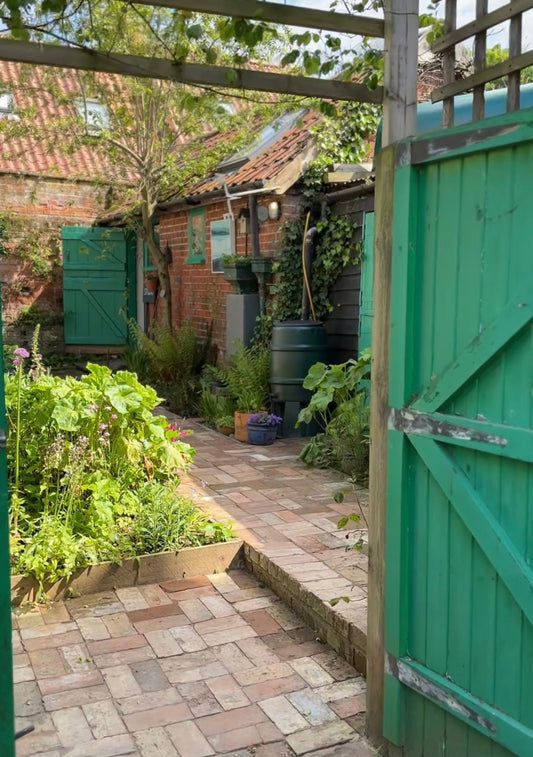
To ground this, I painted a close-up, examined, ink image of flowers from the studio garden—the very thing the Western eye demands: transparency, scrutiny. Flowers linked back to the work I did with Cambridge Botanical gardens about plant taxonomy and how the classifications and physical labelling are embedded within the science and enlightenment historical context. I then declared Glissant’s position materially: using an opaque white to block, to refuse, juxtaposed with a transparent yellow. The yellow, suggesting light or clarity, is intentionally layered with the refusal of the white. It turns a formal decision about paint quality into a philosophical statement.

The Visceral Self: Confined and Protected
The third activity, exploring my relationship to my body, was the most personal and, I think, the most obvious/illustrative. The language I used was visceral: feelings towards my body of being trapped, coiled, limited, and hidden. I worked on a wooden panel, taking cues from photographs, a mirror, and found images, all in an attempt to capture this profound duality of the figure shape and the duality of hiding and confining.
 .
. 
The central formal decision here was absolutely crucial: I left light within the figure shape itself. That light is something I am actively protecting. It's the self’s core, something that remains irreducible even when the external form is coiled and uncomfortable. I intentionally sat the figure uncomfortably in the composition and image frame to emphasise that tension. I set the figure fighting with a painted space - the irony!!

This exploration led directly into my sketchbook with the paper cuts of the primate position, which perfectly embodies the contradiction I’m seeking: limited and potentially afraid versus strong and primal versus weak and hiding. The self is complex; the representation must be, too. The representation felt uncomfortable and illustrative.
The Defining Question
The final activity—painting the smell of the studio garden—missed the necessary conceptual hook or personal friction that the others possessed. It just didn't land.
But the successful activities confirm where the energy lies: in the intersection of theory (Glissant’s Opacity) and personal, physical sensation (Confinement). This practice has crystallised the driving question of the work right now.
The movement from pure gesture to conceptual and visceral exploration confirms that the work needs to exist in the friction between what is revealed and what is held back.
How can the structure and surface of a painting serve as a material means of ontological self-defence? If the work must be 'read' or exhibited, can its formal and material choices—its use of opaque materials, its uncomfortable composition—actively resist that reading, safeguarding the central, essential element: the hybridity of my lived existance. It’s about using paint’s inherent ability to hide as much as it reveals.